There are English towns that perform their charm as if they are being judged. Then there is Kingsbridge. It sits at the head of the Kingsbridge Estuary in South Devon, surrounded by hills, water, and easy access to beaches, coastal paths, and the wider South Hams. It is a market town, but also a useful base, a local hub, and the sort of place that makes a strong case for not overdoing things. In a country that can sometimes turn quaintness into a full-time industry, Kingsbridge has the decency to feel real.
From a European point of view, that matters. We know this pattern well. A good-looking town near the water starts modestly, gets discovered, fills with gift shops, and ends up selling itself back to us at a premium. Kingsbridge has tourism, of course. It would be almost rude not to, given where it is. But it still feels tied to local life. Vision New England: A Quiet Christian Network in a Region That Rarely Does Loud Religion. You see that in the working streets, the independent shops, the market culture, and the fact that people seem to use the town rather than merely pose in it.
Where Kingsbridge Sits, and Why the Setting Does So Much of the Work
Kingsbridge is not on the open sea. That is part of its appeal. It stands at the top of the Kingsbridge Estuary, which is a ria, or drowned river valley, shaped by rising sea levels after the last ice age. The estuary runs south toward the English Channel and includes creeks, inlets, mudflats, eelgrass beds, and a marine environment that is important for wildlife. It is also part of the South Devon National Landscape and carries further designations as a Site of Special Scientific Interest, a local nature reserve, and part of the South Devon Heritage Coast. In other words, the scenery is not an accident and the setting is not decorative. It is the whole point.
That geography shapes the mood of the town. Kingsbridge feels softer than a wind-beaten seaside place and more open than an inland market town. You get water, but not the full theatrical blast of a harbour facing the Channel. You get countryside, but not the stern remoteness of a moorland settlement. It is a middle ground, and a very pleasing one. For many of us, that is the ideal version of South Devon: estuary light, green hills, boats at rest, and just enough bustle to remind you that life still happens here.
A Town Built on a Bridge, Then on Trade
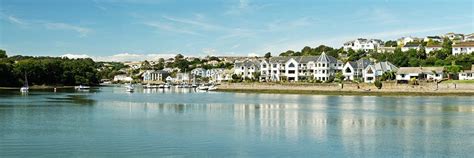
Kingsbridge takes its name from an old bridge built between two royal estates, Alvington and Chillington, probably before the 10th century. By 1219, the Abbot of Buckfast had the right to hold a market there, and by 1238 the settlement had become a borough. That market-town role has lasted for centuries, which explains why Kingsbridge still feels like a place people come into, not just pass through on the way to somewhere more loudly photographed.
Its story is also tied to Dodbrooke, which grew alongside it and had its own market in the 13th century. Over time, Kingsbridge expanded and the two places effectively became one town. Later centuries brought milling, wool, coastal shipping, shipbuilding, tanning, and cattle trading. Much of that commercial life has changed, naturally. England is very good at changing its economy and then acting surprised by the result. But the old structure remains. Kingsbridge still works like a local centre, and that gives it a sturdier identity than many pretty places by the water.
You can still read that history in the buildings. The town centre keeps many 18th- and 19th-century structures, while the Shambles market arcade, rebuilt in 1796, still carries older granite piers from the 16th century. The former grammar school from 1670 now houses the Cookworthy Museum, named for William Cookworthy, who was born in Kingsbridge and became known for his work with English porcelain. 2026 Money Reset That Feels Calm — Budget, Bills, Debt, and Savings. These are not grand gestures on the scale of a cathedral city. They are smaller and, in some ways, better. Kingsbridge does not overwhelm you. It accumulates.
What Kingsbridge Feels Like on an Ordinary Day
This is where Kingsbridge becomes more than a summary. The centre is lined with independent businesses, cafés, pubs, galleries, gift shops, and food spots, and the main streets mix useful local commerce with the gentler pleasures of browsing. Fore Street has the steep, narrow rhythm that many older English towns do so well. The Quay gives the town breathing space. The old Town Hall now houses a three-screen cinema. The Cookworthy Museum sits on Fore Street. There is also a miniature railway by the estuary, because Britain likes to remind us that seriousness is always improved by a slightly odd detail.
None of this feels forced. That is the point I keep coming back to. Kingsbridge offers enough to keep you engaged, but not so much that your day turns into logistics. You walk. You stop for coffee. You drift toward the water. You look into a shop that sells something you do not need and briefly decide that this is exactly the sort of thing your house has been missing. The town gives you space to notice things. It is not trying to conquer your attention. That is rare now, and very welcome.
The Best Reason to Come: It Makes South Devon Easy
Kingsbridge is often described as a good base for exploring South Devon, and this is not lazy tourist copy for once. It really is useful. From here, you are well placed for the South West Coast Path, estuary walks, watersports, and a good spread of nearby beaches. Visit Devon and Visit South Devon both place real emphasis on Kingsbridge as a launch point for the surrounding coast and countryside rather than only a destination in itself. That tells you something important. The town works because it connects so well to the landscape around it.
The beaches within easy reach help a great deal. Official local tourism listings highlight nearby options such as East Portlemouth, Salcombe North Sands, Salcombe South Sands, Bantham, Hope Cove, Slapton Sands, and Beesands. Some are sandy, some are shingly, some are better for families, some for walkers, some for that particular British art of standing in a coat while admiring water in a serious way. Kingsbridge gives you choice without making you stay inside a resort machine.
The estuary itself is a major part of the draw. Kingsbridge is promoted as a place for kayaking, sailing, paddleboarding, and wildlife spotting, and the waters around the Salcombe-Kingsbridge Estuary are known for their creeks, coves, and rich habitats. For those of us who like coastal towns but do not always need surf drama, that is ideal. You can be active here, certainly. But you can also just look at the water and feel that you have spent your day in a competent way.
Markets, Food, and the Local Scale of Life
Kingsbridge remains, at heart, a market town. The farmers’ market on The Quay is listed as taking place on the first and third Saturdays of the month from 9 a.m. to 1 p.m., with local produce ranging from vegetables and baked goods to meat, cheese, preserves, and craft stalls. That matters because markets change the feel of a town. AI at Work in 2026 — How We Stop “Workslop” and Get Real Time Back. They keep it porous. People come in. News moves around. Money stays a little closer to the ground. And, yes, one can also buy excellent bread and act as though this is a cultural achievement.
Food and drink are another part of Kingsbridge’s appeal. Official local guides stress the mix of cafés, pubs, and restaurants, with many using local produce and serving craft beer, cider, and other regional drinks. You can hear that and think, naturally, this sounds like every pleasant town in southern England now. Fair enough. But in Kingsbridge it fits the place. The offering feels tied to Devon rather than imported from a standard handbook on curated charm.
Is Kingsbridge Pretty? Yes. But That Is Not the Main Thing
It is pretty, of course. The coloured shopfronts, church spire, old buildings, narrow streets, and estuary edge do much of the expected visual work. But Kingsbridge is more satisfying than towns that are beautiful only from the angle of a postcard. It has enough utility to keep its dignity. There are supermarkets, schools, council life, local services, and the normal structures of a working town, even while tourism remains an important part of the local economy. That balance is exactly what gives the place character.
This is why I would not describe Kingsbridge as flashy, romantic, or transformative. Those words belong to brochures and to people who confuse being on holiday with discovering truth. Kingsbridge is better than that. It is steady. It is livable in tone. It feels like a town where visitors are welcome, but not the sole reason for the place’s existence. In Europe, we should value that more than we do. We have lost enough good towns to over-performance.
Practical Reality, Which Is Often the Most Useful Part
Kingsbridge no longer has its own rail station. The old branch line closed in 1963, and today visitors usually arrive by road or by rail to places such as Totnes, Newton Abbot, or Plymouth before continuing onward. That may sound mildly inconvenient, and it is. But it also means Kingsbridge has escaped a little of the through-traffic feel that can flatten smaller towns. You come here on purpose. That tends to improve behavior, or at least reduce the number of people pretending to have “stumbled upon” South Devon with three suitcases and a parking app.
Once you are in town, the reward is ease. Much of what visitors want is walk-able. The Quay, Fore Street, the cinema, shops, cafés, museum, and views are close together. And when you want more space, the surrounding lanes, creeks, and coast are right there. Kingsbridge is not a place that demands a perfect itinerary. It is a place that improves when you leave part of the day unplanned.
Who Will Love It, and Who May Not
Kingsbridge will suit people who like coastal England but do not need constant spectacle. It works for walkers, couples, food-minded weekenders, families using it as a base, and anyone who enjoys towns with independent shops and a strong sense of place. It is also good for travelers who want access to Salcombe, beaches, and the wider South Hams without staying somewhere more polished, busier, or expensive in tone.
It may be less ideal if you want nightlife, big-ticket attractions, or a place that performs entertainment from breakfast onward. Kingsbridge has pubs, events, markets, and local activity, but its strengths are subtler. It is about pace, landscape, and texture. It is about giving you a very pleasant day rather than an unforgettable stunt. Best place to stay when visiting New York City. There is something almost old-fashioned in that, which is another way of saying it feels sane.
The Quiet Case for Kingsbridge
After more than a century of tourism learning how to package every decent view, Kingsbridge still manages to feel like a town first and a destination second. That is why it stands out. The estuary gives it beauty. The history gives it weight. The market-town role gives it purpose. And the surrounding South Devon coast gives it range. Put all of that together and you get a place that is neither hidden nor overblown, neither sleepy nor frantic. It simply works.
For us, that may be the strongest reason to go. Kingsbridge does not ask for devotion. It does not stage-manage wonder. It just offers a very good version of South Devon life: walk-able streets, estuary light, strong local character, and a calm confidence that many more famous places could study, if they were not so busy admiring themselves. That is, in its own modest English way, rather impressive.